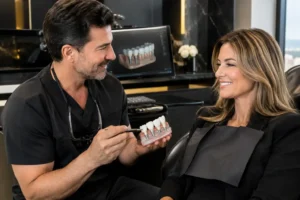

A full mouth implant second opinion is not a sign that you are difficult, indecisive, or unwilling to move forward. It is a sensible step when the treatment affects how you eat, speak, smile, and feel about yourself every day. Full-arch dental implants are a major investment in your health and quality of life. You deserve clarity before you commit to a plan that cannot simply be undone.
For many people, the first consultation happens after years of broken teeth, loose dentures, repeated crowns, infections, and the quiet frustration of avoiding certain foods or hiding their smile. Relief can make a fast promise feel compelling. But “teeth in a day” is a treatment concept, not a guarantee that every provider uses the same surgical standards, materials, planning, or long-term restorative approach.
Why a Full Mouth Implant Second Opinion Matters
A full-mouth restoration requires more than placing implants and attaching a bridge. The provider must evaluate your bone, bite, gum health, facial structure, medical history, airway considerations, and long-term ability to clean and maintain the final teeth. The quality of those decisions shapes comfort, appearance, function, and durability for years to come.
A second opinion can confirm that your original plan is sound. That alone can provide valuable peace of mind. It can also reveal that important questions were left unanswered: whether teeth that can be saved are being removed too quickly, whether the number and position of implants support the proposed bridge, whether grafting or advanced techniques are needed, or whether a low initial quote omits the final teeth, sedation, follow-up care, or future maintenance.
The goal is not to find someone who tells you what you want to hear. It is to find an experienced full-mouth implant provider who can explain what you need, why you need it, and what the trade-offs look like in plain language.
Signs You Should Seek Another Expert Review
Some treatment plans deserve an especially careful review. Consider a second opinion if you were told you need same-day treatment without a detailed discussion of your medical history, CT imaging, bite, or final restoration. The convenience of immediate fixed teeth can be life-changing, but it should be built on disciplined diagnostics and planning.
You may also want another evaluation if the proposed price is dramatically lower than other estimates. Lower cost does not automatically mean poor care, and a higher fee does not automatically mean better care. Still, full-mouth implant treatment includes many variables: surgical expertise, anesthesia, facility standards, imaging, laboratory work, titanium framework design, zirconia quality, temporary teeth, final teeth, and post-treatment support. A quote only means something when you understand exactly what it includes.
Other reasons to pause include being offered a long-term temporary bridge without a defined path to final teeth, being told that severe bone loss is an automatic disqualification, or feeling pressured to place a deposit before you understand your alternatives. Patients with failed implants, broken full-arch bridges, chronic discomfort, or a history of multiple dental repairs should be particularly selective. Complex cases call for deeper experience, not simpler sales language.
What a Thorough Review Should Examine
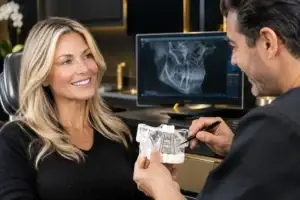
A meaningful second opinion begins with records, not assumptions. That often includes a 3D CT scan, digital photographs, intraoral scans, and a careful review of your health history. The purpose is to see the anatomy beneath the gumline and create a treatment plan around your actual needs, rather than fitting you into a one-size-fits-all protocol.
Your Bone and Implant Foundation
Bone volume and bone quality influence where implants can be placed and how they can be angled, stabilized, and loaded. An experienced provider should explain whether you have enough foundation for a fixed full-arch restoration, whether grafting is appropriate, and whether advanced implant placement techniques may help avoid unnecessary delays.
Severe bone loss does not always mean you cannot receive fixed teeth. It does mean the surgical plan should be more sophisticated. The right answer depends on your anatomy, medical health, implant history, and restorative goals.
Your Bite, Speech, and Facial Support
A bridge can look attractive in a photograph and still be wrong for the person wearing it. The position of the teeth affects speech, lip support, facial proportions, chewing forces, and the way your jaw closes. If a bridge is too bulky, too long, poorly shaped, or designed without respect for your bite, daily comfort can suffer.
Ask how the provider determines tooth position and vertical dimension. Ask who designs the final smile and whether you will have input on shape, shade, and overall appearance. Fixed teeth should feel like part of you, not like a cosmetic appliance placed over your mouth.
Materials and Long-Term Serviceability
Not every full-arch bridge is made the same way. A premium final restoration may use durable zirconia supported by a precisely engineered titanium framework, while other options may rely on more provisional materials or designs that are harder to repair and maintain. There is no single material that is perfect for every patient, but the recommendation should be specific and defensible.
Ask what material will be used for your immediate teeth and what material will be used for your final teeth. Ask whether the bridge is designed for retrievability, how hygiene visits are handled, and what happens if a repair is needed. A permanent solution should come with a clear plan for caring for it.
Questions Worth Asking at a Second-Opinion Consultation
You do not need to become an implant expert before your appointment. You do need honest answers. A qualified provider should be comfortable discussing why implants are being recommended, what alternatives exist, and where uncertainty remains.
Ask how many full-mouth implant cases the doctor has personally completed, not simply how many implants the practice has placed. Ask whether treatment is performed in an accredited surgical setting and who will manage sedation and recovery. Ask to see cases similar to yours, especially if you have bone loss, failed implant treatment, or a damaged existing bridge.
It is also reasonable to ask whether all stages of treatment are coordinated in-house or spread across separate offices and laboratories. When the surgical and restorative teams work closely together, the implant position, temporary bridge, and final smile can be planned as one connected treatment. That coordination matters when precision is the difference between merely having teeth and having teeth that look natural, feel secure, and function beautifully.
A Second Opinion Is Not Always a Different Answer
The best second opinion may validate the first plan. If two experienced providers independently recommend a similar path, you can move forward with greater confidence. The differences may come down to materials, timing, facility standards, financing structure, or the level of support you receive during recovery.
Sometimes, however, the second evaluation identifies a real concern. Perhaps the original plan relied on too few implants for your biting forces, overlooked a failing tooth that needs attention, or presented a temporary restoration as a final solution. Perhaps the recommendation to remove all remaining teeth was made without a meaningful discussion of preservation. Those are not small details. They are decisions that can affect your life for decades.
At Golpa NexGen Smiles, patients seeking expert review receive a treatment-focused evaluation built around advanced digital planning, premium restorative materials, and decades of full-mouth implant experience. For patients traveling to Las Vegas, the process is designed to bring high-level surgical and restorative care together with concierge-level guidance.
Choose Clarity Over Pressure
The right full-mouth implant decision should feel informed, not rushed. You should understand what will happen on treatment day, what you will wear during healing, when final teeth are delivered, what materials are included, and how your smile will be supported over time.
If your current plan leaves you with more pressure than confidence, give yourself permission to ask another expert to look closely. A carefully chosen second opinion can protect more than your investment. It can help you choose a new smile that gives you the comfort to eat freely, the confidence to be seen, and the reassurance that experience makes all the difference.